The Postcode Divide: How Geography Is Quietly Determining the Ceiling of Britain's Young Athletes
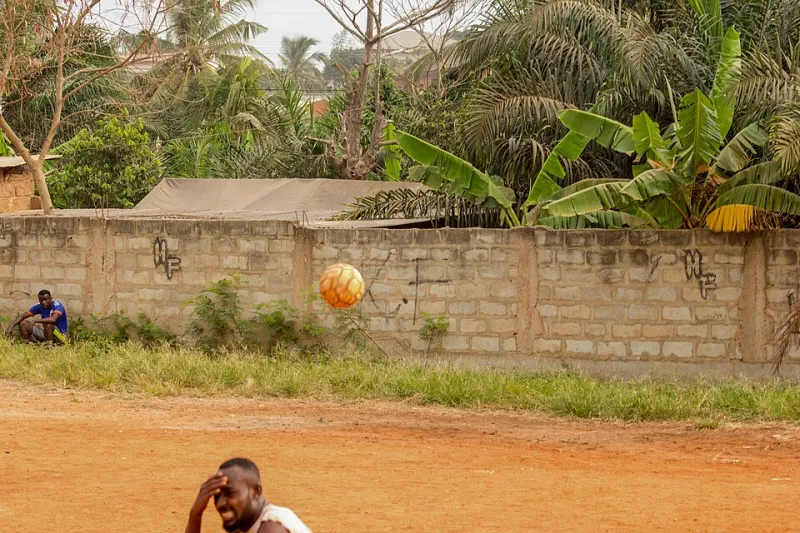
Photo: Dapsonishmeal, CC BY-SA 4.0, via Wikimedia Commons
The Postcode Divide: How Geography Is Quietly Determining the Ceiling of Britain's Young Athletes
Consider two children. Both are eleven years old. Both demonstrate the kind of instinctive spatial awareness and ball control that experienced coaches identify as markers of genuine potential. One lives in a market town in rural Northumberland. The other lives in the Trafford borough of Greater Manchester. By every measure of raw talent, they are equals. By every measure of opportunity, they are not.
This is not a hypothetical designed to provoke sentiment. It is a structural reality embedded so deeply within British youth sport that it has come to feel, to many involved in grassroots development, almost inevitable. It should not. And the fact that it persists — quietly, systematically — represents one of the most significant failures in the governance of British youth athletics.
Mapping the Inequality
The distribution of UEFA-licensed and FA-qualified coaches across England alone reveals a concentration pattern that mirrors broader economic geography with uncomfortable precision. Urban centres — particularly those with established professional club infrastructure — command a disproportionate share of highly qualified coaching personnel. The further one moves from these gravitational centres, the thinner the provision becomes.
Data from the FA's coaching qualification registers indicates that regions such as the North East, rural Wales, and large parts of Scotland outside the central belt have significantly lower densities of coaches holding Level 2 qualifications or above per head of youth sporting population. This is not simply a reflection of population distribution. When adjusted for the number of registered youth players in each region, the gap remains stark.
The consequences extend beyond the quality of individual sessions. Qualified coaches bring with them an understanding of long-term player development principles, safeguarding protocols, sports science literacy, and the kind of structured progression that transforms promising youngsters into complete athletes. Their absence is not merely an inconvenience — it is a ceiling.
The Facility Gap
Coaching quality does not exist in isolation. The physical environments in which young athletes develop matter enormously, and here the geographic lottery is equally pronounced. Sport England's Active Places data consistently demonstrates that maintained, floodlit, all-weather pitches are concentrated in urban and suburban areas, while rural and post-industrial communities frequently rely on poorly drained grass surfaces that become unusable for significant portions of the winter calendar.
For a young footballer in a rural setting, this can mean losing three to four months of structured practice time annually — time that their urban counterparts, training on 3G surfaces in heated facilities, do not lose. Over the course of a developmental career spanning ages eight to sixteen, that accumulation of lost hours is not trivial. It is the difference between a player who has logged sufficient deliberate practice to compete at regional level and one who has not.
The disparity in facility quality also affects the breadth of sporting opportunity available. Many rural communities lack the infrastructure to support swimming programmes, indoor athletics tracks, or gymnastics facilities — sports that, when experienced alongside football in early childhood, are now understood to contribute significantly to overall athletic development. The multi-sport pathway, increasingly endorsed by sports science research, is simply not accessible to children in significant parts of the United Kingdom.
The Club Provision Problem
Beyond coaching and facilities lies a third dimension of inequality: the structural sophistication of local clubs themselves. In well-resourced urban areas, a young athlete may have access to clubs that run age-group teams from under-sevens through to under-eighteens, employ welfare officers, maintain links with professional academy scouting networks, and offer pathways into county and regional representative programmes.
In rural and economically deprived areas, the local club is frequently a volunteer-run organisation operating on minimal funds, fielding a single age group, and struggling to maintain the administrative capacity to participate in county cup competitions, let alone engage meaningfully with formal development pathways. The coaches who give their time to these clubs are often outstanding human beings whose commitment to young people is beyond question. But commitment is not a substitute for resources, and resources are not equally distributed.
The consequence is that talented young athletes in underserved communities may never be identified by the systems designed to find them. Scout networks, regional trials, and academy assessments all operate more efficiently in environments where clubs are organised, coaches are qualified, and fixtures are regularly played. The child in rural Northumberland may simply never appear on the radar of those with the power to accelerate their development.
What Governing Bodies Must Do
The Football Association, Sport England, the Welsh Football Association, and the Scottish FA each possess the institutional authority to address geographic inequality in meaningful ways. The question is not whether the tools exist — they do — but whether the political will to deploy them consistently and at scale is present.
Coaching bursary programmes that specifically target rural and economically deprived areas must be expanded and better publicised. The current provision, whilst not without merit, is insufficient to close a gap that has widened over decades. A coach qualification in Trafford is no more valuable than one in Tynedale — but the barriers to obtaining it differ dramatically, and governing bodies must account for that difference in how they structure their support.
Capital investment in facility development must be directed by need rather than by population density alone. The communities that most lack adequate sporting infrastructure are frequently those least able to generate the matched funding that grant programmes often require. Funding models that do not account for this structural disadvantage will continue to concentrate investment where it is already least scarce.
The Role of Sports Trusts and Local Authorities
Organisations like The Shots Trust occupy a crucial position in this landscape. Community-based sports trusts, working in partnership with local councils, schools, and national governing bodies, have the local knowledge and relationship capital to identify gaps in provision and respond to them with a speed and specificity that centralised bodies cannot match.
Local authorities, for their part, must resist the temptation to treat sports facility maintenance as a discretionary budget line. The evidence connecting youth physical activity with educational attainment, mental health outcomes, and long-term economic productivity is sufficiently robust that investment in sporting infrastructure is, in the most literal sense, an investment in community wellbeing.
Talent Is Everywhere. Opportunity Is Not.
The young athlete in rural Northumberland deserves the same chance as the one in Trafford. Not because sport is merely a leisure activity to which all should have equal access — though that argument is valid — but because Britain's long-term sporting success depends upon identifying and developing talent wherever it emerges. Every child whose potential is capped by postcode rather than ability is a loss not only to themselves, but to the broader sporting culture that might have benefited from their contribution.
The geographic lottery is not an act of nature. It is the product of accumulated policy choices, funding decisions, and institutional priorities. It can, therefore, be changed. The question is whether those with the authority to change it consider it urgent enough to act.