Cage, Court, and Concrete: How Britain's Urban Play Spaces Are Forging Elite Athletes
Cage, Court, and Concrete: How Britain's Urban Play Spaces Are Forging Elite Athletes
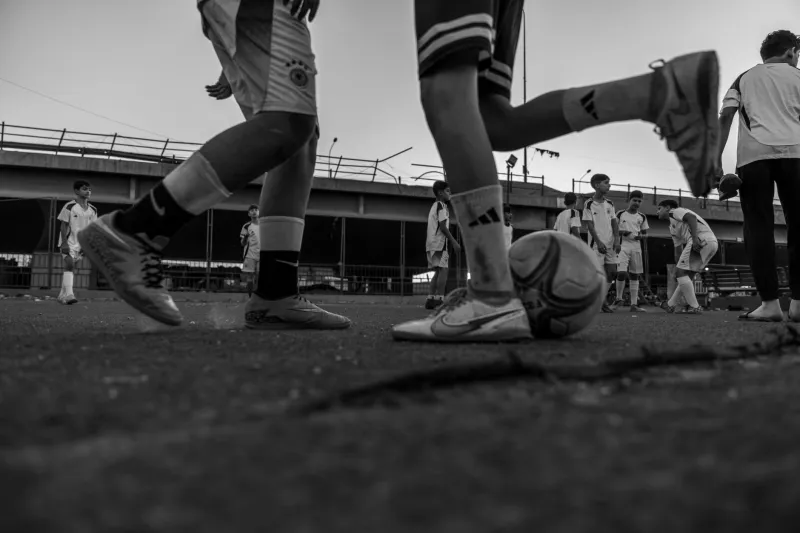
In a caged five-a-side pitch tucked beneath a motorway flyover in Salford, a group of teenagers are playing football with an intensity that no training session could manufacture. There are no coaches present, no bibs, no cones arranged in neat geometric patterns. There is, however, an extraordinary level of technical invention, spatial awareness, and competitive determination on display — qualities that elite academies spend considerable resources attempting to instil through structured methodology.
This scene, replicated across Britain's urban landscapes from Moss Side to Peckham, from Toxteth to Hackney, represents something that sports development professionals are beginning to examine with renewed interest: the incubatory power of informal, community-led street sport.
The Tradition That Was Almost Lost
For much of the twentieth century, Britain's streets, parks, and public spaces served as the primary development environment for the nation's most gifted athletes. The improvised games played on tarmac playgrounds and in terraced back alleys produced generations of technically proficient footballers, basketballers, and boxers who learned their craft not through coached repetition but through the unforgiving feedback loop of competitive informal play.
The gradual erosion of this culture — driven by urban redevelopment, traffic growth, increased parental concern about unsupervised outdoor activity, and the parallel expansion of structured youth sport — has been well documented. What has received rather less attention is the quiet, determined effort underway in many of Britain's cities to reverse that erosion.
A network of community-led programmes, many operating with minimal funding and maximum ingenuity, is reclaiming neglected urban spaces and using them to develop athletic talent in ways that challenge conventional development orthodoxies.
What the Cage Teaches That the Academy Cannot
The physical environment of street sport — tight, unforgiving, socially intense — creates a development context that is genuinely difficult to replicate within structured settings. Understanding precisely what that environment produces helps explain why so many elite athletes, when asked to identify the most formative experiences of their development, return not to academy training sessions but to informal games played in public spaces.
Decision-making under pressure is perhaps the most significant quality cultivated through urban street sport. In a caged pitch or a congested basketball court, the consequences of poor decisions are immediate and social — your team loses possession, your opponent scores, the watching crowd reacts. This creates an intensity of feedback that accelerates the development of spatial intelligence and anticipatory thinking in ways that drills conducted in spacious training facilities rarely achieve.
Creativity, too, flourishes in constrained environments. When a young footballer has only two metres of space in which to operate and opponents who know him personally and are determined to embarrass him in front of his peers, the impetus to develop unconventional solutions is considerable. The elaborate skill sets associated with players who grew up in urban street sport environments — the feints, the disguised passes, the rapid changes of direction — are not the product of coached instruction. They are survival mechanisms developed through thousands of hours of high-stakes informal competition.
Physical adaptability is another dividend of concrete and tarmac development. Playing on hard surfaces demands a different relationship with the ball and with one's own body mechanics. The control required to manage a football on uneven concrete, or to absorb contact on a basketball court with no give underfoot, builds a physical intelligence and bodily awareness that grass-based training environments do not replicate.
Programmes Making a Difference
Across Britain, a growing number of organisations are working to harness and formalise the developmental power of urban street sport without destroying the qualities that make it distinctive.
In Manchester, cage football leagues operating across some of the city's most economically deprived neighbourhoods have become a recognised pathway for identifying and nurturing young talent. Organisers are careful to preserve the competitive, self-directed character of the games while providing light-touch mentorship and, crucially, a safe and consistent physical environment in which young people can participate year-round.
In South London, basketball programmes operating from community courts in Brixton, Stockwell, and Lewisham have established a reputation for producing players who arrive at structured club environments with exceptional individual skills and an unusually developed competitive mentality. Several former participants have progressed to professional and semi-professional levels in both basketball and football, crediting their early urban court experiences as foundational.
In Bristol, a community trust operating a network of outdoor futsal courts in inner-city areas has documented measurable improvements in the technical proficiency of young players who participate in their informal leagues compared with peers of equivalent age in structured academy settings. The data, while preliminary, is consistent with broader international research suggesting that the density of technical decision-making in small-space, informal competition accelerates skill acquisition significantly.
The Funding Paradox
For all their developmental value, urban street sport programmes operate in a fundamentally precarious funding environment. The community organisations sustaining these initiatives frequently rely on a patchwork of local authority grants, charitable donations, and the voluntary labour of committed individuals whose dedication to their communities far exceeds any financial compensation they receive.
This precarity stands in sharp contrast to the substantial institutional investment directed towards elite academy structures. A Category One academy affiliated with a Premier League club may spend hundreds of thousands of pounds annually on coaching staff, sports science provision, and facility maintenance. A cage football programme serving three hundred young people across a deprived urban neighbourhood may operate on a fraction of that sum.
The irony is not lost on those working within these community environments. The athletic qualities that elite clubs subsequently seek to develop in their academy players — creativity, decision-making under pressure, competitive resilience — are being produced organically and economically in urban spaces that receive a fraction of the institutional attention or resource.
Bridging the Worlds
The most thoughtful voices within British sports development are not arguing that informal urban sport should replace structured coaching. They are arguing that the two must be understood as complementary rather than competing, and that the talent emerging from cage pitches and concrete courts deserves the same recognition and developmental support as that identified through conventional academy pathways.
Some clubs are beginning to act on this understanding, establishing formal links with urban street sport programmes and creating structured but sensitive pathways for talented young people to transition between informal and institutional environments without losing the qualities that made them distinctive.
At The Shots Trust, we believe that athletic excellence does not belong exclusively to those with access to premium facilities and professional coaching structures. It emerges wherever young people are given the space, the safety, and the freedom to compete, to fail, and to grow. Britain's cages and courts are not the margins of sporting development. For many of the country's most talented young athletes, they are the very beginning.