When the Streets Went Silent: Reclaiming the Lost Art of Playground Football in Modern Britain
The Great Silence
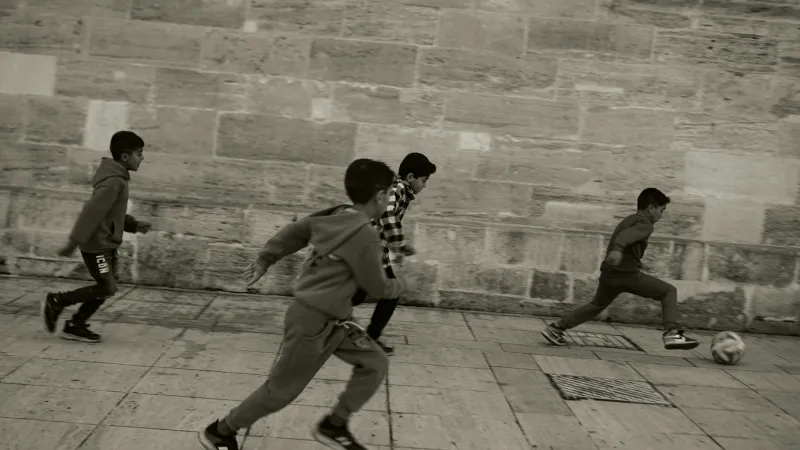
Walk through any British housing estate today and you'll encounter an eerie quiet where once the sound of leather against brick walls provided the soundtrack to childhood. The spontaneous football that shaped generations of British legends has virtually vanished, taking with it something irreplaceable: the chaotic, joyful laboratory where creativity flourished without coaching manuals or performance targets.
This isn't merely nostalgic romanticism. The structured environments that replaced street football, whilst well-intentioned, cannot replicate the unique developmental conditions that produced the improvisational genius we associate with British football's golden eras.
The Unstructured Advantage
Street football operated under completely different rules from organised sport. Games adapted to available space, player numbers fluctuated constantly, and problems required instant solutions rather than coached responses. These conditions created players who thought independently, adapted quickly, and developed an intuitive understanding of space and timing that formal training struggles to replicate.
Professor Michael Thompson, whose research at Manchester Metropolitan University examines informal sport development, argues that street football's greatest contribution was its complete absence of adult intervention. "Players learned to negotiate rules, resolve conflicts, and adapt strategies without external guidance. These skills transferred directly to match situations where coaches couldn't provide immediate solutions."
 Photo: Manchester Metropolitan University, via yadros.net
The psychological benefits proved equally significant. Without adult supervision, young players took risks freely, experimented with techniques, and developed personal playing styles without fear of criticism or tactical constraints.
The Perfect Storm of Disappearance
Multiple factors converged to eliminate street football from British culture. Urban planning prioritised car access over community spaces, whilst health and safety concerns restricted informal gatherings. Rising traffic volumes made road games impossible, and the proliferation of private gardens reduced communal areas where football naturally occurred.
Simultaneously, the digitalisation of childhood entertainment provided compelling alternatives to physical activity. Video games offered immediate gratification without requiring social coordination or physical exertion, whilst online content consumed time previously dedicated to outdoor exploration.
Parental attitudes shifted dramatically as well. Generations who grew up playing street football now consider similar activities unsafe, preferring the controlled environments of organised clubs and structured activities.
The Creativity Crisis
The consequences extend far beyond football participation rates. Modern players, despite superior technical training and tactical understanding, often lack the improvisational instincts that characterised previous generations. The ability to solve problems creatively under pressure – a hallmark of street football graduates – appears increasingly rare in contemporary British football.
Youth coaches frequently observe that today's players excel when executing practised patterns but struggle when situations deviate from familiar scenarios. This predictability, whilst tactically sound, limits the creative unpredictability that historically defined British football's international identity.
Artificial Recreation Attempts
Recognising these deficits, progressive organisations across Britain are attempting to recreate street football's essential characteristics within safe, supervised environments. These initiatives face the fundamental challenge of maintaining spontaneity whilst ensuring safety and accessibility.
The Shots Trust has observed several innovative approaches emerging across the country. Manchester's 'Urban Playground' programme transforms unused car parks into informal football spaces during specific hours, encouraging unstructured play whilst maintaining adult oversight. Similarly, Birmingham's community centres have introduced 'chaos sessions' where traditional coaching rules are suspended in favour of creative experimentation.
Community-Led Solutions
The most successful recreations emerge from genuine community ownership rather than top-down initiatives. Resident groups who remember street football's golden age often provide the most authentic environments for its revival.
In Liverpool, former players have established 'heritage football' sessions that explicitly reject modern coaching methodologies. These gatherings prioritise fun over development, yet paradoxically produce superior creative outcomes compared to traditional structured training.
Similarly, London's estate communities have reclaimed underutilised spaces for informal football, creating environments where children can experience something approaching historical street football conditions.
The Role of Local Authorities
Local councils possess significant power to facilitate street football's return through thoughtful urban planning and community investment. The most progressive authorities recognise that small interventions – installing goals in appropriate locations, designating car-free hours, or simply tolerating informal gatherings – can dramatically increase opportunities for unstructured play.
However, this requires cultural shifts within local government, moving away from risk-averse policies towards community-focused approaches that prioritise long-term social benefits over immediate liability concerns.
Technology as an Ally
Counterintuitively, technology might assist street football's revival rather than hindering it. Mobile applications can coordinate informal gatherings, whilst social media helps communities identify suitable spaces and organise regular sessions.
Some groups have successfully used online platforms to recreate the organic social dynamics that historically sustained street football culture.
The Coaching Evolution
Formal football coaching must also adapt to address creativity deficits. The most innovative coaches deliberately incorporate unstructured elements into training sessions, creating controlled chaos that mirrors street football's unpredictability.
These approaches require significant cultural changes within youth football, where structured progression and measurable outcomes often take precedence over creative development.
A Cultural Imperative
Reclaiming street football represents more than sporting nostalgia; it addresses fundamental questions about childhood development, community cohesion, and cultural identity. The skills developed through informal play – creativity, resilience, social negotiation, and independent problem-solving – extend far beyond football into every aspect of adult life.
As British football faces increasing international competition, the creative advantages historically provided by street football become more valuable, not less. The challenge lies in recreating these conditions for a generation that has never experienced them naturally.
The future of British football's creative identity may depend on our ability to restore what progress inadvertently destroyed: the simple joy of children playing football in the streets, learning lessons no coach could ever teach.