The Silent Stadium Syndrome
Every Tuesday evening at grassroots clubs across Britain, the ritual unfolds with predictable precision. Young footballers line up behind a neat row of balls, methodically striking each one into the bottom corner whilst their coach calls out encouragement from the sideline. "Good technique, keep it simple," echoes across empty pitches from Merseyside to the Midlands.
Yet when these same players step up in cup finals or crucial league matches, with parents screaming from touchlines and teammates' dreams hanging in the balance, something extraordinary happens. Technically perfect penalty takers crumble. Balls sail over crossbars, shots scuff wide, and promising young careers bear psychological scars that last years.
The Academy Awakening
At Manchester City's elite academy, sports psychologist Dr Sarah Mitchell has been revolutionising how penalties are taught. "We discovered that players who could slot twenty consecutive penalties in training were missing crucial spot-kicks in matches," she explains. "The disconnect was staggering."
Her research, conducted across three seasons with academy players aged 14-18, revealed that traditional penalty practice bore virtually no correlation to match performance. Players succeeding at 95% in training environments dropped to 67% success rates when genuine pressure was applied.
"The problem isn't technical," Mitchell continues. "These young players have excellent technique. What they lack is experience making decisions under acute psychological stress."
Beyond the Comfort Zone
The solution implemented at City's academy challenges conventional coaching wisdom. Instead of repetitive technical drilling, penalty sessions now incorporate deliberate stressors designed to replicate match conditions.
Players must complete fitness challenges before taking penalties. Teammates create noise and movement behind goals. Coaches introduce artificial consequences – miss three penalties and the entire squad runs extra sprints. Most importantly, penalty practice occurs only after intense small-sided games when players are physically and emotionally drained.
"We're not just training the technique," explains academy coach James Sullivan. "We're training the decision-making process under fatigue, pressure, and distraction. That's what penalties actually are in matches."
The Grassroots Revolution
This psychological approach is gradually filtering down to grassroots level, where innovative coaches are adapting elite methodologies for community club environments. At Wythenshawe Amateurs FC in Manchester, under-16s coach Paul Henderson has transformed his penalty training entirely.
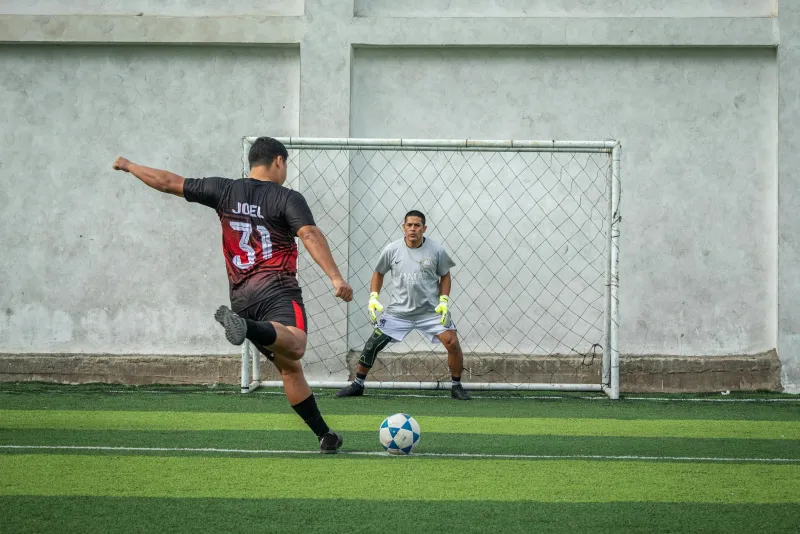
 Photo: Wythenshawe Amateurs FC, via squad.co
"We used to spend twenty minutes having lads take turns shooting at an empty goal," Henderson recalls. "Now we never practice penalties without pressure. Players take spot-kicks after running shuttles, with music blaring, teammates cheering for the goalkeeper, and real stakes attached to outcomes."
Henderson's methods mirror research from the German Football Association, which found that penalty success rates improved by 23% when training incorporated psychological pressure elements rather than pure technical repetition.
The Visualisation Component
Sports psychology research emphasises that penalty taking is fundamentally about decision-making rather than ball-striking ability. Dr Mitchell's work with City's academy incorporates visualisation techniques borrowed from Olympic sports.
"Young players must rehearse not just the physical action, but the entire emotional journey," she explains. "Walking to the penalty spot, hearing crowd noise, feeling nervous energy, then channelling that into focused execution."
This mental rehearsal extends beyond training sessions. Players practice visualisation techniques at home, imagining high-pressure scenarios and their responses. The approach treats penalties as complex psychological challenges requiring comprehensive preparation rather than simple technical skills.
Implementation for Every Coach
Grassroots coaches need not replicate expensive academy facilities to implement pressure-based penalty training. Simple modifications can transform traditional sessions:
Create artificial pressure through team challenges where penalty success determines training activities. Practice penalties only when players are tired from previous exercises. Introduce noise, movement, and distraction during spot-kick attempts. Most crucially, attach genuine consequences to penalty outcomes during training.
The Development Dividend
Clubs implementing psychological penalty training report benefits extending far beyond spot-kick success rates. Players demonstrate improved composure in other high-pressure situations, enhanced decision-making under fatigue, and greater mental resilience throughout matches.
"Teaching young players to perform under pressure creates better all-round footballers," observes Henderson. "The penalty work improves their finishing, their composure in one-on-ones, even their ability to take crucial free-kicks."
Changing the Culture
The shift from technical to psychological penalty preparation represents a broader evolution in youth coaching philosophy. Rather than pursuing perfect technique in controlled environments, progressive coaches are creating training scenarios that mirror the unpredictable, high-stakes nature of competitive sport.
For Britain's youth development system, this psychological awakening cannot come soon enough. Too many promising players have been derailed by penalty failures that could have been prevented through proper mental preparation. The solution lies not in perfecting technique, but in preparing young minds for the beautiful chaos of competitive football.